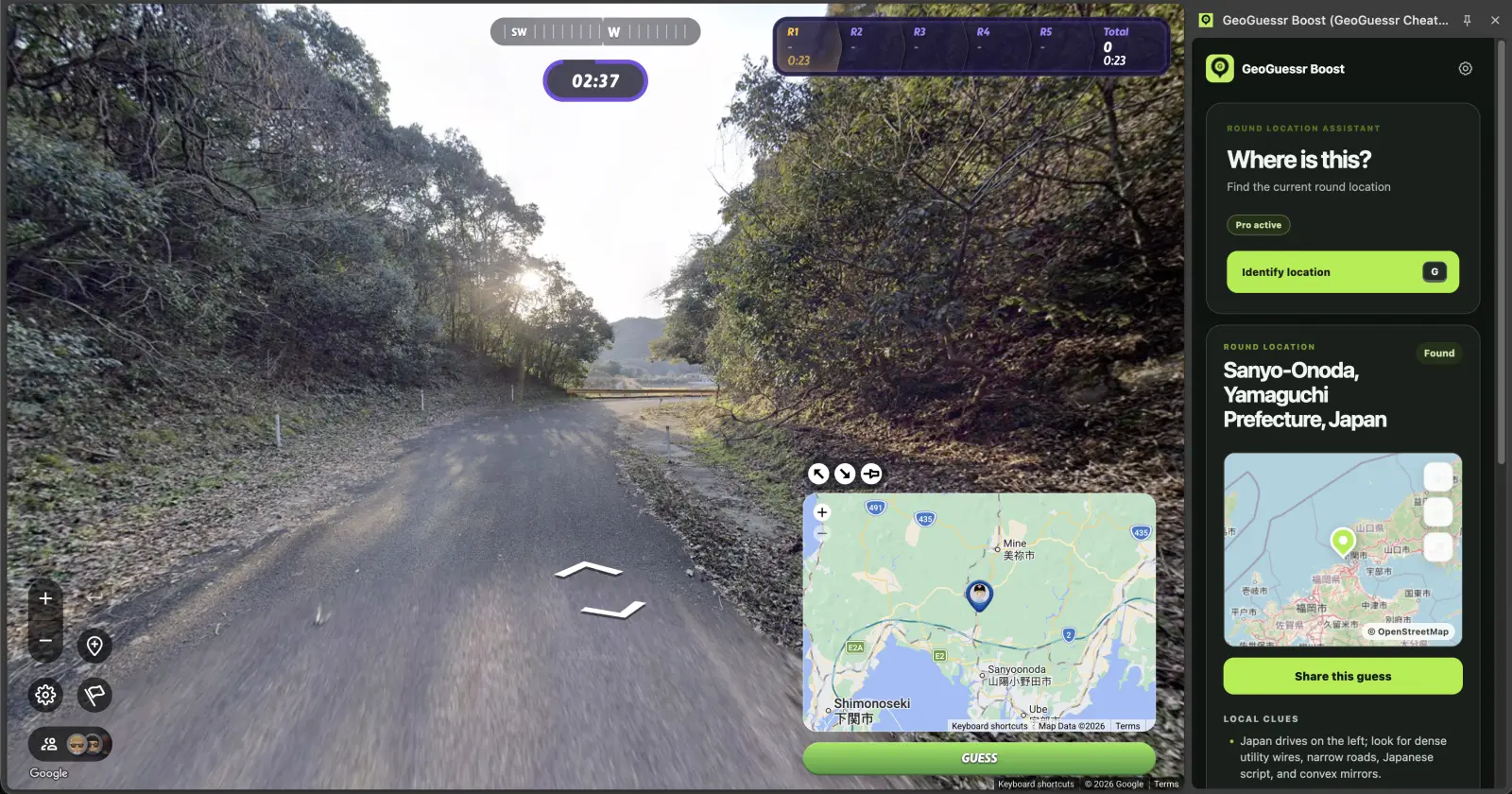
How to cheat in GeoGuessr is a high-intent search: the player wants a faster path from a confusing round to a useful map decision. This guide explains the practical use case, what to verify manually, where GeoBoost helps, and where helper tools should stay out of the game.
Built for supported private games, practice, testing, party rounds, and personal entertainment.
Independent product, not affiliated with GeoGuessr.
Supported round. Exact.Map point foundCoordinates
Updated
Tested with
GeoBoost 1.0.9
Intended use
Private, practice, and testing rounds
Known limits
Supported modes only; never ranked or competitive play
01
Best use cases
Use this workflow when the goal is speed, feedback, or an agreed private-game reveal, not when other players expect strict manual guessing.
How to cheat in GeoGuessr should answer a concrete player job, not act like a generic promise. The page is built around supported rounds, private rules, and a faster feedback loop.
private games where everyone agrees
practice reveals
testing supported extension workflows
02
A practical workflow
A good helper workflow still has order. The round should move from a quick visual read to a supported check, then to placement or review.
Decide the rules before play.
Use a first manual guess when practicing.
Run GeoBoost only on supported rounds.
Do not bring helper workflows into ranked or no-helper games.
03
Manual clues to check
Even with a helper, the most useful players keep a short clue checklist. It makes the result easier to trust and turns a reveal into practice.
whether the lobby allows tools
what you want to learn from the round
whether exact placement is necessary
how to explain the reveal to other players
04
Where GeoBoost fits
GeoBoost gives a controlled helper flow: five starter guesses, one daily free guess, and Unlimited for repeated supported use without a guess limit. Every free guess includes all features.
05
Limits and fair-use context
Cheating language attracts broad searches, but the product should be used honestly in agreed private, practice, testing, and personal contexts.
06
Understand the four different shortcut workflows
Players use the word cheat for several different workflows: external search, saved clue notes, AI image analysis, and browser extensions that return a supported round point. They do not provide the same result. Search and notes still require clue interpretation. AI proposes a location from the image and can be wrong. A supported browser helper can return a direct point and placement controls, but only on compatible pages.
Choose the workflow by the job. For learning, make a manual guess before opening notes or a reveal. For an agreed party mode, a direct reveal may be the format. For testing, use the smallest action that confirms the integration works.
07
Keep assisted play outside competition
GeoGuessr's published Community Rules identify third-party software, scripts and external information used for an unfair advantage as cheating. Leaderboards and competitive play are therefore the wrong context for GeoBoost or any comparable helper.
Private does not automatically mean permitted: tell the other players which tools are active and what they do. A clear assisted-reveal rule is better than a hidden advantage because everyone can predict the format before the round begins.
08
Use a manual-first reveal if the goal is practice
Give yourself a short decision window, record the country and the strongest clue, then reveal the supported point. Compare the answer with the original clue cluster and write one rule that would have improved the guess. This preserves the effort that creates learning while shortening the feedback delay.
 GeoBoost